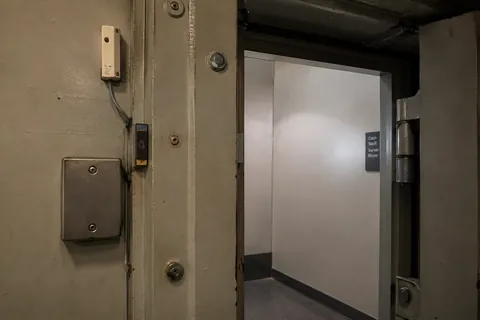
System 04 of 07
Intrusion & hold-up
An intrusion system is judged on how often it raises a false alarm and whether anybody responds when it raises a real one. Both are design decisions rather than product decisions, and a system that fails the first test is always switched off before it gets a chance to fail the second.
What this system covers
- Perimeter detection
- Fence-mounted, buried or beam-based, zoned closely enough to tell an operator where rather than only that.
- Internal detection
- After-hours protection sized to the building's actual unmanned pattern rather than to a standard layout.
- Safe and strongroom protection
- Seismic, vibration and dual-technology detection matched to what the insurer requires and what the risk actually is.
- Hold-up devices
- Panic and duress devices connected to a defined receiving station, tested on a schedule, and logged.
- Signalling and receiving
- The path by which an alarm leaves the building, with monitored integrity rather than a phone line nobody checks.
- Verification
- Video or sequential confirmation before a response is mobilised, because unverified alarms stop being answered.
Design decisions
Eight choices that determine whether an intrusion system is acted on or switched off.
- 01 Getting the false alarms out before anybody stops believing itEvery one of these is a site behaving normally, not a detector behaving badly. Run the first year on both and watch what happens to the one thing that made the system worth having.
Never re-tuned
Trust in the system 0%
- Wk 2Stray dog, east wallFalse
- Wk 3Branch grown into the beamFalse
- Wk 6Tempo unloading at 06:10False
- Wk 9Housekeeping, back gateFalse
- Mth 4Branch again, east wallFalse
- Mth 5Stray dogNobody went
- Mth 6Contractor, no noticeNobody went
- Mth 8Zone switched offDisabled
- Mth 11Somebody on the wallNothing happened
Re-tuned after go-live
Trust in the system 56%
- Wk 1Stray dog, east wallFalse
- Wk 2Branch grown into the beamFalse
- Wk 5Tempo unloading at 06:10False
- Wk 6Engineer re-set it on siteFixed
- Mth 4All quietNone
- Mth 7All quietNone
- Mth 9Somebody on the wallGuard sent
Never re-tunedA stray dog. A branch that has grown into the beam. A tempo unloading at six in the morning. Every one of them wakes somebody up and every one of them is nothing. By month five the guard stops walking out. By month eight somebody quietly switches that zone off, and nobody writes it down.
Re-tuned after go-liveThree false alarms in the first six weeks, then an engineer comes back and sets it against how the site actually works. After that it stays quiet, so when somebody really is on the fence in month nine, the guard goes.
Nothing broke. Every detector is still on the wall and still working. What was lost is the one thing that made them worth having. Somebody willing to go and look.
- 02 An alarm that tells you where, not just thatHalf a kilometre of boundary wall. Something crosses it. Tap any part of it.
- 1
- 2
- 3
- 4
- 5
- 6
- 7
- 8
PerimeterTap any part of the boundary.
One zoneHe knows something touched the wall. He does not know where. So he walks the whole boundary, and by the time he reaches the right spot, it is over.
Eight zonesHe knows which twenty metres. He goes straight there, and he arrives while it still matters.
- 03 Seeing what set it off before sending anybodyTwo in the morning. The north wall alarms. This is everything the guard has to go on.
Cam 07 · north wall · 02:14
No image.
No camera on that zoneAt two in the morning somebody has to decide whether to send a man out for something that is probably nothing. After the fourth time it was nothing, they stop sending anybody.
Camera: first tap, the dogIt is a dog. Nobody is woken up, nobody drives out, and nobody loses a little more faith in the system. Tap again: it is not always a dog.
Camera: second tap, the manThis time it is a man, on the wall, at 02:14. The guard goes, and he goes knowing exactly what he is walking towards. That is the whole reason the camera is on that zone.
- 04 Detection selected for the environment, not the roomWind, animals, vegetation, heat sources and vibration each defeat a different technology. A single detector type across a site is a specification that will be disabled by month three.
- 05 Hold-up devices connected to a defined receiving station and tested on a scheduleWho receives it, what they do, and how often it is proven. A device that has never been pressed is a device that has never worked.
- 06 Signalling path redundancy decided against the response timeWhat happens when the primary path fails, and how quickly that failure is known. On a remote site this is the whole design.
- 07 Set and unset designed around how the site runsShifts, overtime, cleaning, deliveries. A schedule that fights the operation is a schedule that gets bypassed with a permanent unset.
- 08 Standby power sized for the actual outage, not the standard figureAnd on a schedule for replacement, because batteries are the only part of the system that fails on a timetable you can predict.
A system nobody trusts is a system nobody answers. Every decision on this page is really about that.
Standards and approvals
- IEC 62642-1, intrusion and hold-up alarm systems
- System requirements and security grades 1 to 4, against which detectors and control equipment are selected. Referenced as the IEC standard.
- Insurer conditions, including Jewellers Block
- Where a policy sets conditions, those conditions govern, and the system is signed off against them line by line.
What we hand over
- Zone schedule
- Every zone, its detection type, and what it protects.
- Detection drawings
- As-built, with coverage rather than symbols.
- Signalling test record
- The path proved end to end, with the receiving station's confirmation.
- Response procedure
- Agreed with the client and the receiving station, in writing.
- Hold-up device register
- Location, type, and the monthly test log format.
- Policy compliance record
- Where an insurer sets conditions, each one signed off against the installed system.
| Interface | Normally contracted to | When it is nobody’s |
|---|---|---|
| Camera verification | Security vendor, assumed by intrusion | Every alarm is unverified, so eventually none are answered. |
| Set and unset from access | Access vendor | Staff arrive, the system is armed, and the false alarm rate does the rest. |
| Fire system coexistence | Fire contractor | An evacuation triggers the intrusion system and the response goes to the wrong event. |
| Receiving station | A third party nobody has tested | Everybody believes there is a response. There is a signal going somewhere. |
Across the spine
Intrusion & hold-up appears at three stages. It governs two.
- 01 Outside the gate : the stage this system governs
- 05 Work areas : the stage this system governs
- 06 Control room
Have an intrusion design you would like reviewed before it goes out?
We review specifications, drawings and cause-and-effect matrices for consultants and project management teams. Findings in writing, no obligation, and no approach to your client.
Findings in writing. No obligation.
Request a design review