Stage 02 of 06
Entry
Who decides what comes in, and is there a record of the decision?
The decision at the gate
Who decided this could come in, and is there a record of it?
A car pulls up at the gate. Press the button on each and watch what the guard does, and what is written down afterwards.
0.0 s
The guard decides
- 09:14:02Vehicle at the boom, not expected
- A car arrives behind
- Another car arrives behind
- 09:14:11Guard decides. Nine seconds, three cars waiting
- Boom lifts, car goes through
- Written down: time and plate. Nothing else.
Already on the system
- On recordPiyush Ganediwala, Flat 1104
- Resident. Two vehicles registered to this flat.
- 09:14:02Plate matches one of the two
- 09:14:04Driver photographed, scan retained
- 09:14:06In. Four seconds, nothing queued.
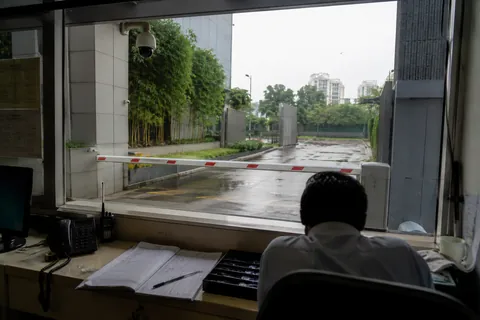
The guard decidesHe looks at the driver, decides on the spot, and lifts the boom. Three more vehicles arrive while he is deciding. What gets written down is a time and a plate, and if anybody asks in six weeks who let this vehicle in, the answer is a man who was not on duty that day.
Already on the systemThe decision was made once, when the flat was registered. The guard is matching a plate, not judging a stranger. The boom is up in four seconds, nothing queues behind, and the record names the person, the flat and the vehicle.
Both cars got in. The difference is that one was a decision made once, calmly, when the flat was registered, and the other was a decision made in nine seconds by a man with three cars behind him.
Three vendors normally share this stage. The barriers are mechanical and come from a civils or automation supplier, the cameras from the security contractor, and the visitor management from a software vendor sold to the admin team. The gate is the one place on site where all three have to agree, and typically none of them was asked to.
What lives at this stage
The point at which something is let in, or is not.
- Boom barriers and blockersVehicle control at the gate, specified for the actual span and the actual traffic rather than a standard width.
- Under-vehicle scanningUVSS at the entry point where the risk or the client's own policy requires it, with the image retained against the entry record.
- Driver and occupant captureA camera position that reads the person, not only the vehicle, at the height a driver actually sits.
- Visitor pre-authorisationThe visitor is expected before he arrives, so the guard is checking a name rather than deciding one.
- The gatehouse itselfWhere the guard sits, what he can see from there, and whether the screen in front of him shows the approach or the lobby.
- Goods and staff separationA delivery and an employee are different decisions. Most gates make them the same one.
What fails here
Entry systems fail at the busiest moment, which is the moment nobody is watching them.
These are the six we find most often on assessment. If two of them sound familiar, the rest are probably true on your site as well.
| What fails | Why it fails | What it costs |
|---|---|---|
| The barrier is left up | Traffic backs up in the morning peak, so somebody props it and nobody lowers it again. | The gate is open. Every record after that point is a record of a gate that was not controlling anything. |
| Visitors are written in a register | The system was specified for vehicles and nobody specified the people. | There is no searchable record of who was on your premises on any given day. |
| The guard's screen shows the wrong thing | Installed facing the lobby because that is where the cable ran. | The one person who could stop something at the gate is watching somewhere else. |
| UVSS images are never retained | Storage sized for cameras, with the scanner treated as a live display. | The scan happened. There is nothing to look at afterwards. |
| Driver faces unusable | Camera set for the plate, at plate height, at plate angle. | You know which vehicle came in. You do not know who was driving it. |
| Deliveries use the staff gate | No separate route was built, so the exception became the rule. | Goods and people move through one uncontrolled point, and neither is properly recorded. |
3
Three vendors normally share this stage. None of them owns the gaps between.
The barrier is a civil and mechanical contract, the scanning system is a specialist supplier, and the visitor management sits with whoever supplied the software. Every failure above lives in the space between two of them, and the BoQ never said whose job that space was.
So on the day it matters, there is nobody to call. Each vendor can show you their own scope, correctly delivered. Nobody has to answer for the join.
How we specify it
Six decisions that determine whether this stage works in year seven.
- Barrier throughput calculated against your actual morning peakCounted on site, not assumed, because a barrier that causes a queue is a barrier that gets propped open by week three.
- Every entry produces a record, whether it is a vehicle or a personOne log, searchable by date and by name, rather than a camera system and a paper register that never meet.
- The guard sees what he needs to act onScreen content decided by what a person at the gate can actually do about it, not by where the cable was easiest to run.
- Scanning output retained on the same schedule as the footageA scan with no retention is a demonstration, not a record.
- Occupants captured separately from vehiclesA second position, at seated head height, specified for windscreen glare.
- A separate route for goods, designed rather than toleratedBecause the delivery exception is what eventually becomes the way everybody enters.
Sector variations
Entry means something different depending on what you are protecting.
Year seven
The gate is the only part of the system that is used by everybody, every day.
Barriers are mechanical. Booms take impacts, motors wear, loop detectors get cut by civil work nobody told you about. Card readers at a gate live outdoors and are touched hundreds of times a day. This is the fastest-wearing stage on the site and the one most likely to be worked around rather than reported.
Nobody raises a ticket for a barrier that is slow. They raise one when it stops. By then it has been slow for months and somebody has already been leaving it up.
What decides whether this stage still works in three years is Maintenance cover and whether anyone has produced a signed condition report since.
Technical reference
Find out
Is your gate actually controlling anything right now?
A signed condition report naming what works, what has failed, and what was never commissioned.
The assessment is chargeable, quoted against the site, and adjusted in full against the first year if you take cover. Where cover is not taken, the fee covers our team’s time on site and the report we leave behind, and the report is yours either way.
Chargeable, and adjusted in full if you take cover.
Book an assessment